Module 5 Descriptive
Writing – Nature’s Wonders
Goals for this Module:
l
Use
descriptive language to express ideas and feelings
l
Move
from “vague” to “vivid”
l
Practice
using various forms of words
l
Practice
revising simple sentences
l
Write
similes and metaphors
l
Describe
a scene in a photo
Part
I. Idea Generating – Nature’s
Wonders
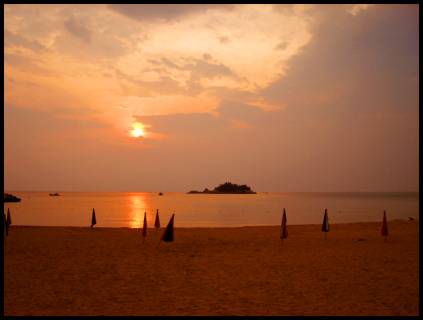
Exercise 1 (pair work)
– Make a list of adjectives that describe the above photo or how the scene can
make someone feel. Your list should have 20 to 30 words. Then compare your list
with other students’ lists.
Example: peaceful
calm
Exercise 2 – Using the words from
exercise 1 write 3 sentences describing the photo:
1)
2)
3)
Working with Words
Exercise 3
List synonyms for the words in the table:
|
quiet |
interesting |
happy |
sad |
big |
dangerous |
|
|
|
|
|
|
|
Exercise 4
Write the various
forms for the following words:
|
Noun |
Adjective |
Verb |
Adverb |
|
|
interesting |
|
|
|
tranquility |
|
|
|
|
|
|
inspire |
|
|
motivation |
|
|
|
|
|
difficult |
|
|
|
|
|
|
calmly |
|
|
|
excite |
|
|
wonder |
|
|
|
|
|
|
wander |
|
Part II. Analyzing Descriptive Writing
Reading 1—Read the following essay and answers the
questions.
Seasonal Changes
The sweltering heat and humidity of summer have given way to the
cool crisp weather of autumn.
For someone like me who has lived years in Los Angeles it is a
pleasant change to be living in a place that has four seasons including a “real”
autumn. Before coming to
Daejeon, my friends told me that the Fall is the most beautiful time in
Korea. So far, I can
agree. However, the pleasant
weather has been just one of the notable changes. From my vantage point living near a university
campus, the change began with the Fall semester and the return of
students. Almost over night
the Jayang Dong area went through a metamorphosis in which throngs
of students suddenly filled the previously quiet streets, restaurants and “hoffs”. The university neighborhood, as all
campuses this time of year, is bustling with young people enjoying
one of the best times of their lives—their change into adulthood. Although change comes with
challenges, changes in life are as inevitable as changes of the seasons.
The seasonal change is visible in so many places. In shops and department stores, the
decorations depict the autumn mood.
The clothes being sold both in boutiques and on the streets downtown
have changed from sexy summer wear to cozy winter warmth. Some traditional Korean restaurants
have changed their menus to draw attention to dishes that fit the seasonal
change. Change is ubiquitous.
Several weeks ago, I was hiking near Gyejoksan when I met a Korean
man the same age as me.
Without giving away our age in numbers, let’s just say we are both
entering the “autumn of life”.
As we walk and talk along the mountain trails he suddenly asked me, “What
is life?” I thought it was
a strange question from someone I had just met, but then I thought he
probably has not met many Americans and wanted to take the opportunity to
get a Westerner’s opinion on the question: “What is Life?”
I thought about it as we walk through the hills. I look around me thinking the
answer must be near. The
leaves were beginning to change color. Locals were beginning to harvest the fruits of
their labor from their mountain gardens. In the valley below, farmers were harvesting some of the
rice they had been growing all summer. I gave my answer to the man. “Change. That is
what life is: Change.” As Autumn comes
with the harvest, cooler weather, full moons, falling leaves and all the
other changes, most people start to reflect on the past year as they
prepare for winter. We reap
our harvest. We prepare for the long cold winter. We evaluate
the changes we have made and we ponder the changes that have made us.
Autumn is truly a beautiful season and a beautiful time to embrace
change.
Exercise 1
– Questions
1)
What
is the main idea of this essay?
Which sentence states the main idea?
2)
What
is the writer comparing?
3)
What
does the writer mean by “autumn of life”?
4)
What
does the writer mean by “the changes that have made us”?
Exercise 2
– Write definitions for the words in bold.
1)
vantage
point –
2)
throngs
–
3)
bustling
–
4)
inevitable
–
5)
ubiquitous
–
6)
harvest
–
7)
reap
–
8)
evaluate
–
Part III. Writing Similes and Metaphors
Descriptive
Writing
Descriptive writing is like painting a picture with
words. Your goal is for your
reader to see the images you have in your mind clearly through words. You want your reader to feel what you
feel. Adjectives, adverbs and descriptive
nouns are the colors you can use to paint with words. Similes and metaphors
can also help to create vivid representations of your ideas for your reader.
Simile – A
figure of speech comparing two unlike objects, phenomenon, animals or people
usually beginning with “like” or “as.”
l
My brother dresses like a clown.
l
The typhoon ripped through the city as if it were a hungry
tiger tearing at its dinner.
l
He runs as slow as a turtle.
Metaphor
- A figure of speech in which a word or
phrase suggests a likeness or analogy between two seemingly unrelated objects
or ideas.
l
She is so rich, she is
drowning in money.
l
The fierce storm dug its
deadly sharp claws into the city ripping roofs off houses and smashing windows.
l
He is such a turtle he will never win
the race.

The monkey looks like ET.
The monkey is as small as a thimble.
The monkey is as cute as a____________________.
The monkey is an ornament.
It’s a space monkey!!!
It’s eyes are marbles.
Exercise
3 – Write a simile and a metaphor to describe the following:
1) your
best friend
2) your mother’s cooking
3) summer
4) getting an “A” on a test (hint: “feels: like”)
5) falling in love
6) life
Part IV. Organizing Ideas for a Paragraph
- Choose a picture to
describe
- Make a list of
descriptive words (use the template)
- Free write for 7
minutes about the photo
- Circle the ideas
you like
- Number the ideas in
the order you think is best
- Write a topic
sentence that can provide the main idea

Part
V. Write a description of a photo.