Module 3 – Cause and Effect
What’s the World Coming to?
|
|
|
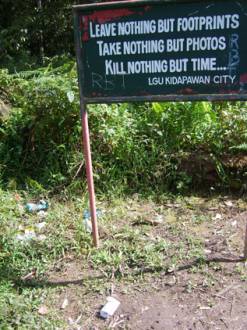
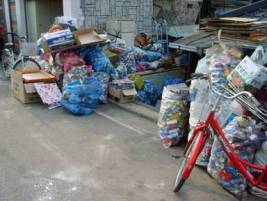
·
Prewriting
–Idea Generating
Discussion questions:
a)
What does the sign in the picture on the left
mean? Look closely at the picture.
Do you see anything that is ironic?
b)
What do you know about the picture on the right?
c)
In your opinion, what is the biggest environmental
problem in your country? …in the world?
d)
Name three things a person can do to live a more
environmentally friendly life?
Reading
1
|
Group Finds 6 million Pounds of Trash on World's Beaches By H. JOSEF HEBERT,
Associated Press Writer The world's beaches and shores are anything but pristine.
Volunteers scoured 33,000 miles of shoreline worldwide and found 6
million pounds of debris from cigarette butts and food wrappers to
abandoned fishing lines and plastic bags that threaten seabirds and marine
mammals. A report by the
Ocean Conservancy, to be released Wednesday, catalogues nearly 7.2 million
items that were collected by volunteers on a single day last September as
they combed beaches and rocky shorelines in 76 countries from Bahrain to
Bangladesh and in 45 states from southern California to the rocky coast of
Maine. "This is a
snapshot of one day, one moment in time, but it serves as a
powerful reminder of our carelessness and how our disparate and random
actions actually have a collective and global impact," Vikki Spruill,
president of the Ocean Conservancy said in an interview. The 378,000
volunteers on average collected 182 pounds of trash for every mile of shoreline,
both ocean coastlines and beaches on inland lakes and streams, providing a
"global snapshot of the ocean trash problem." The most extensive cleanup was
in the United States where 190,000 volunteers covered 10,110 miles — about a
third of the worldwide total — and picked up 3.9 million pounds of debris on
a single Saturday last September, according to the report. That's 390 pounds of trash per mile,
among the highest rates of any country, although the high number also
reflects the large number of U.S. volunteers who took part, said Spruill. By
comparison, volunteers in neighboring Canada collected 74 pounds per mile and
those in Mexico, 157 pounds per mile, said the report. About 65 pounds of
trash were collected per mile in China and 46 pounds per mile in New Zealand.
Volunteers covered one mile in Bahrain and found 300 pounds of trash. But Spruill said
the volume of trash collected tells only part of the story. It's the items
that are found that tells us about the behavior of people enjoying the
beaches and coastlines of the world.
"It represents a general carelessness we have. We're the bad
guys. Trash doesn't fall from the sky. It actually falls from our
hands," The debris ranges from the relatively harmless, although
annoying and an eyesore, to items that annually result in the death of
hundreds of thousands of seabirds and marine mammals caught in abandoned
fishing lines and netting. A
third of the items found came from smokers. The volunteers collected and cataloged nearly 2.3 million cigarette
butts, filters and cigar tips. And they found 587,827 bags; more than 1.7
million food wrappers, containers, lids, cups, plates and eating utensils;
and nearly 1.2 million bottles and beverage cans. Divers also scoured
waters offshore, collecting about 160,000 pounds of debris from cigarette
waste and food containers to more threatening items: abandoned fishing lines,
plastic bags, rope, fishing nets and abandoned crab and lobster traps. The International Coastal Cleanup
also focused attention on the damage these items can do, said program
sponsors. The volunteers came
across 81 birds, 63 fish, 49 invertebrates, 30 mammals and 11 reptiles and
one amphibian that all had become entangled in various debris, most often
discarded fishing line, rope or plastic bags, according to the report. Among other items that entangle animals and birds were balloon ribbons and strings, building material, vehicle tires, wire, and beverage six-pack holders. In all, 57 percent of the trash was related to shoreline recreational activities, 33 percent from smoking-related activities, 6.3 percent from fishing or waterway activities, 2 percent from dumping and less than 1 percent from medical and personal hygiene activities, said the report. |
Questions for Discussions
- What do the beaches
in your country look like?
- What should the
government do to alleviate the trash and litter problem along coastlines?
- How can individuals
help to protect natural environments?
- How do you react
when you see someone littering?
Video:
http://www.youtube.com/watch?v=u9N9uCI2dgs&feature=related
http://www.youtube.com/watch?v=fXMumKbUs9E&feature=related
Considering a Topic
It is important to
focus on a topic for essay #3 soon as possible. The sooner a writer decides a
general topic, the easier it is to move from idea generating to organizing
ideas. Therefore, choose one of the following general topics to consider while
preparing to write essay #3:
·
What
factors have led to the degradation of the environment?
·
What
can people do to alleviate the impact of human behavior on the environment?
·
How
does environmental degradation impact the lives of the economically
disadvantaged?
·
How
do environmental problems affect people’s health?
AFTER
YOU CHOOSE A TOPIC START WORKING ON AN ANGLE!!!
(TIP: Start thinking
of causes and effects!!!)