
Expense Tracker for Fixed Income

Having recently retired, I understand the importance of living within the limits of a fixed income. Leaving a job or career is daunting enough when a person also has to think about how to fill their time, stay healthy, and maintain a sense of contribution to the greater community. Therefore, it is essential to minimize financial worries through sound money management.

The first step toward managing your money is knowing exactly where the money is going. With the assistance of ChatGPT, I have created an easy-to-use expense tracker in Microsoft Excel. I am attaching the file along with an editable prompt, so anyone can use it or tailor it to their own individual needs.


The Prompt

Please create a simple Microsoft Excel household expense tracker.

The file title should be: Household Monthly Expenses

Purpose:
I want to track monthly household expenses and see totals by category and by month.

Workbook structure:
Please create one Summary sheet and one detailed monthly expense sheet for each month of the year.

Each monthly sheet should use this layout:

Column A: Category
Column B: Date
Column C: Amount
Column D: Payment Method
Column E: Notes

Please put the expense categories in Column A as fixed rows. Some categories should have subcategory rows underneath them. The parent category row should contain a formula in Column C that totals the subcategory rows.

Use these example categories:

Rent
Water
Electricity
Internet / WiFi
Phones
Gas / Cooking Fuel
Drinking Water
Groceries
Beverages / Snacks
Household Necessities
Transportation
School Tuition
School Expenses

Clothes — Total

  • Adult 1
  • Adult 2
  • Child

Medical — Total

  • Health Insurance
  • Adult 1
  • Adult 2
  • Child

Dental / Orthodontist — Total

  • Adult 1
  • Adult 2
  • Child

Entertainment — Total

  • Eating out
  • Day trips
  • Miscellaneous entertainment

Subscriptions — Total

  • Streaming
  • Apps / Software
  • Other subscriptions

Miscellaneous

Formula requirements:
The parent category rows must automatically total their subcategory rows. For example:

Clothes — Total should total Adult 1, Adult 2, and Child.
Medical — Total should total Health Insurance, Adult 1, Adult 2, and Child.
Dental / Orthodontist — Total should total Adult 1, Adult 2, and Child.
Entertainment — Total should total Eating out, Day trips, and Miscellaneous entertainment.
Subscriptions — Total should total Streaming, Apps / Software, and Other subscriptions.

The monthly total row should add only the main category rows and parent category total rows, not the subcategory rows, so there is no double-counting.

The Summary sheet should automatically pull the totals from the same fixed cells on each monthly sheet. It should show:

  • Categories down the left side
  • Months across the top
  • Monthly totals
  • Annual totals

Formatting:
Use simple, clean formatting. Do not make it too colorful. Use currency formatting for the Amount cells. Add a payment-method dropdown list with options such as Cash, Bank transfer, Credit card, Debit card, E-wallet, Check, and Other.

Please include an Instructions sheet explaining how to use the tracker and which cells contain formulas.
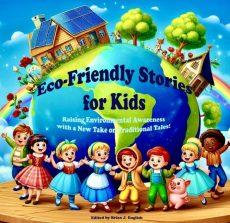
New Book: Eco-Friendly Stories for Kids

“Eco-Friendly Stories for Kids” puts a green twist on some of our favorite children’s stories. From the Coastal Piper’s enchanting melody that inspires a community beach clean-up to Little Green Riding Hood trying to save the forest, these 10 stories aim to foster an Environmental Ethic for kids. The illustrated stories are fun and all have happy endings!


Here is the list of stories:

  • Jack and the Sustainable Beanstalk
  • Little Mermaid’s Ocean Adventure
  • Three Billy Goats Gruff
  • Cinderella
  • The Coastal Piper’s Melody
  • Eco-Little and the Falling Leaves
  • The Sloth and the Cheetah
  • The Three Little Pigs
  • Little Green Riding Hood
  • The Emperor’s New Clothes
Buy it now on Amazon.com

Two Great Books for ESL/EFL Reading Classes

Homeless Bird  by Gloria Whelan

This is a magnificent story of Koly, a young Indian girl. Her life changes dramatically after she is forced into an arranged marriage. Her dream world of comfort and love comes to an end when she is sent off to marry a sickly boy who soon dies and leaves her as a 13-year-old widow. While it would appear as though Koly’s only hopes for happiness are in the hands of her new family, she soon realizes that true happiness must come from within.  The book takes the reader on an emotional journey as Koly travels through India battling adversity in her search for happiness.

Although it is a story of a teenage girl, it is a story that can be enjoyed by both young women and young men. Anyone who reads this book will be moved by Koly and her determination.

Using this book in an ESL/EFL reading class is an excellent way to help students learn about Indian culture as well as acquire new English vocabulary. The writer uses very descriptive language to tell this beautiful story. In addition, the story helps to raise awareness of social issues and gender issues that are common in many countries around the world.

Another advantage of using this book with second language learners is that Gloria Whelan’s prose is rich with metaphors. This is important because metaphors and similes are common in daily conversation and in pop culture. Metaphors and similes are also the beginnings of understanding and formation of analogies in higher levels of communication. The ability to infer meaning from new metaphors takes practice and helps to build critical thinking skills that are essential for a language learner’s meta-linguistic analysis during the language acquisition process.


Children of the River by Linda Crew

This is a heart-warming story of Cambodian refugees living in America. Although the story is set in the backdrops of the Cambodian Civil War and conflicts in Southeast Asia that continued throughout the 1970s, the situation is very relevant to the refugee crises that are taking place in the world today.

It is a story that teaches the reader about cultural differences and the difficulties of living in a new culture. The story’s main character is a Cambodian girl, Sundara. She fled Cambodia with her aunt’s family to escape the Khmer Rouge army when she was thirteen, leaving behind her parents, her brother and sister, and the boy she had loved since she was a child. Four years later, in America, she is struggling to fit in at her high school while still trying to keep her Aunt’s expectations that she should be “a good Cambodian girl” at home. A good Cambodian girl never dates, so Sundara is told she must wait for her family to arrange her marriage to a Cambodian boy. Despite this, Sundara and an American boy begin to fall in love.  The power of love draws them to each other. However, Sundara cannot forget her family that she left behind in Cambodia.  It is that grief for her lost family and for the life left behind that makes Sundara want to be with the American boy, Jonathan. The closer she grows to Jonathan, the more she wonders if her hopes for happiness and new life in America are disloyal to her past and her people.

This is a wonderful story for all young people and especially those interested in learning about the challenges of living in a new culture.


Questions or Suggestions

If you have any questions about these books or about how to use them for teaching reading in the ESL/EFL classroom, please leave a comment. Also, let me know of any suggestions you many have!